
Milliblog Weeklies – India’s only multilingual, weekly, new music playlist.
Week 297: YouTube | Spotify
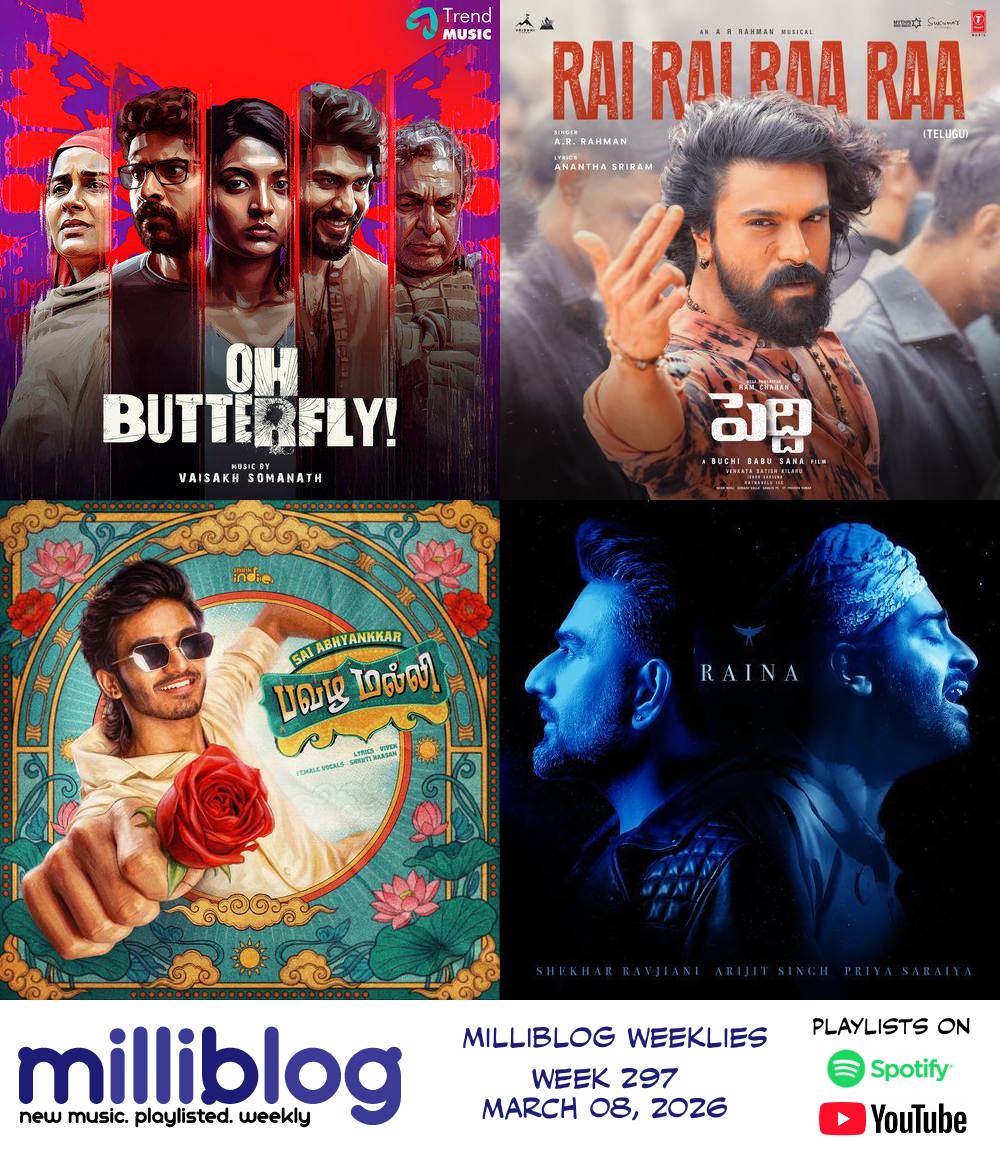
Suzhal, Tururu, Aagaya Neelam – Oh Butterfly (Vaisakh Somanath) – Tamil: After last week’s Pogaadhe, I was looking forward to the full sountrack (since the film release yesterday, though to generally undrwhelming reviews – sadly) and Vaisakh does not disappoint! The soundtrack is pretty impressive! Vaikom Vijayalakshmi actually gets a different type of song away from what she’s persistently called for, in Suzhal. The break in the tune is really interesting, given that the opening of the pallavi consists of 2-word phrases! Tururu offers a fantastic rock-style melody headlined by Haricharan, even as the core tune took me back to Ilayaraja’s iconic ‘Mazhai Varuthu’ from Raja Kaiya Vecha (similar raaga?). The interludes too are strikingly good, featuring a lovely brass piece. Vaisakh sings Aagaya Neelam himself, and this too is a highly listenable melody that flows beautifully. I would love to hear more from Vaisakh in the future – I hope he gets more movies and also works on his own independent music.
Paathakathi – Vadam (D.Imman) – Tamil: Very typical of Imman – he uses what felt to me like Charukesi raaga to create a deeply melancholic effect for the melody with even the words evoking a similar sadness. Shweta Mohan’s voice carries the pain in the melody really well.
Manadhiley, Amma Thaaye, Aaradi Kaathirukku – Thaai Kizhavi (Nivas K Prasanna) – Tamil: In Manadhiley, the real surprise starts first when the techno music opens what felt like the first interlude, after a searing pallavi. And then the rap starts (‘Soppana Sundari’) that was even more of a surprise! Nivas confidently blends both the segments smoothly. With Amma Thaaye, I was expecting a sentimental, slow number, but Nivas completely shocked me with a vibrant, semi-classical nadaswaram-layered tune that has a pulsating rhythm too! Aditi Shankar leads Aaradi Kaathirukku, which, as per the lyrics, is supposed to be an elegy of sorts (which still surfaces in the interlude), singing about someone who is deceased, but Nivas turns it into a lively dance number! Totally enjoyable. After Bison, I see Nivas taking bigger bolder risks and directions in his music and that such stances working really well! This is also the second song this week that has the Tamil word. ‘Pathakathi’ in it, after the one from Vadam!
Aura 10/10 – Meesaya Murukku 2 (Hiphop Tamizha) – Tamil: This is perhaps the most enjoyable song from Hiphop Tamizha for me, in a very long time. I had long given up on his music. To be sure, his nasal, droning voice continues to be odd to me, but in this song, it actually works, given that it is what powers the ‘aura pathukku pathu’ hook!
Rai Rai Raa Raa – Peddi (A R Rahman) – Telugu: After a very long time, an instantly likeable racy song by Rahman that is also truly electric. When Anirudh had almost taken total lease for this kind of musical genre, it’s terrific to see Rahman unleash something in his own style where everything works. The lead towards the Scottish music-style first interlude (starting with ‘Berugga’) is a lovely touch, as also the entire first interlude. Rahman’s voice too adds phenomenally to the song.
Rajamma – Band Melam (Vijai Bulganin) – Telugu: Vijai’s jaunty tune depends on the choice of singer, and Ram Miryala delivers so very well. The lengthy phrases after the ‘Rajamma’ hook like adds considerably to the tune’s charm.
Laali Laali – Saraswathi (Thaman S) – Telugu: A very pleasant melody from Thaman that seems to have subtly used Rahman’s Jodi number, ‘Oru Poiyavadhu Sol KaNNe’ in a very clever manner. Good singing by Sunitha Upadrasta.
Kuan Tara – Bara Badhu (Gaurav Anand) – Odia: This is probably the first Odia song in Weeklies if I’m not mistaken! To be honest, I first heard Papon’s song in this soundtrack (Kuni Kuni), but more than that song (a reasonably good song), this sone immediately stood out for me! The musical style reminded me of the new-age Marathi film music from the likes of AV Prafullachandra and Gulraj Singh. Both the singer, Sourav Bharadwaj and Arpita Choudhury do a great job of Gaurav’s dreamy melody.
Raina – Shekhar Ravjiani, ft. Arijit Singh (Hindi/Indipop): Is this Arijit’s first independent song after announcing his retirement from playback singing? Looks ot be so. Shekhar’s music has a pleasant soft-rock throwback to the pre-internet, early 2000s pop music template and Priya Saraiya’s lines stand out beautifully. Like, “Subah ho jaaye phir bhi na kehti woh jo hai kehna”. Arijit breathes life into the melody like only he can, though all this seems too simple for his standards.
Dhaage – Shamir Tandon (Hindi/Indipop): Shamir’s melody has a whiff of the 1970s. Anand’s ‘Na Jiya Jaye na’ (Salil Chowdhury), to be specific! It’s a lovely, relaxed melody that lands beautifully with the vocals of Papon and Madhubanti Bagchi, with the latter’s voice being an X factor, considering she is heard outside her ‘Aaj ki raat’ template.
The Last Letter – Maan Panu (Hindi/Indipop): Maan’s new song has the same unhurried, calming effect as Justh’s Chor. The tune has a hypnotic flow that keeps coming back to the hook where the 2nd word of both lines (baat, chaap – for instance) is slightly dragged to create a lovely effect.
Pavazha Malli – Sai Abhyankkar (Tamil/Indipop): Beyond the broad feeling that all of Sai’s songs sound similar (probably because of his voice and way of singing is unique enough, and perhaps they do have common elements), the man continues to plough through another catchy number. Like his earlier songs, there are individual segments that are very, very catchy, almost like they were concocted specifically for short Insta reels. Like that 4-liner starting with, ‘Podi Knuckle Ah Vanchinu Thavila Adikka’. Or another 4-liner, ‘Retta Rendaka Mathalam Kattuna Jodi’. Or ‘Sithappu Chikkunu Chikkunu Varaale’. Or ‘Ada Ittu Kolam Pottu’, my favorite given the up and down cadence of the melody. I suppose that’s also Sai’s trademark – he doesn’t as much compose a full song (at least in pop music, not necessary in films, yet) but imagines a ‘song’ as several smaller segments that can go viral online and bring attention to the full song. This is not very different from how critics talk about many Tamil or Telugu movies these days – they seem like one short scene after another all ending with a twist or a high, as if the makers have predecided the attention levels of their audience and are drip-feeding short, easy-to-digest segments.